
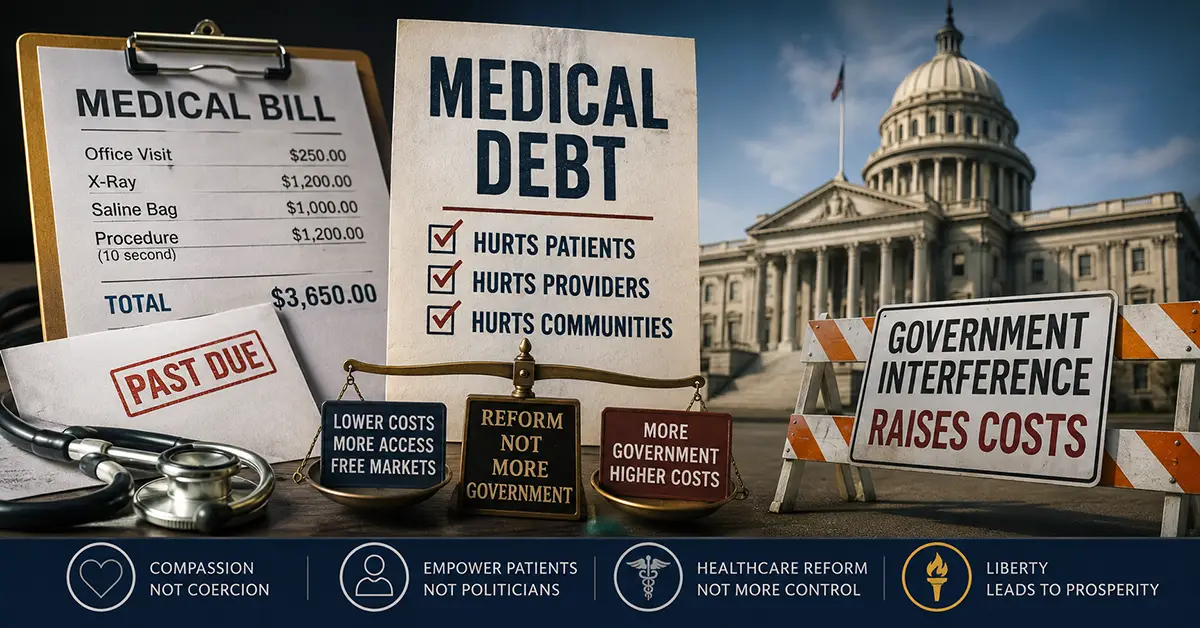
Individuals across the entire political landscape overwhelmingly agree that reform is needed to address the high costs of medical care in this country. Libertarians understand that more government involvement leads to higher costs, as is true in every industry the government subsidizes. Unsurprisingly, Democrats and Republicans fails to grasp this concept and there is a bipartisan push to alleviate the harm of the high costs of medical care through government action. One of those actions is to eliminate or hamper the collection of medical debt.
Medical debt can include costs from a voluntary and routine visit to a local practitioner, as well as costs from the ICU that stemmed from an unforeseen accident. Medical debt can include $1,000.00 for a saline bag and over $1,200.00 for the ten second procedure needed to pop a dislocated pinky back into place (trust me I know).
Regardless of the causes behind inflated healthcare costs, universal and broad anti-collection legislation cannot be the answer to combat the costs. Ohio is one of several states where there is a bipartisan push against the collection of medical debt. There are pending companion bills in each chamber of the Ohio General Assembly that would hamper medical debt collection and thus harm the Ohioans the bill aims to protect. If passed, the bills would reduce or eliminate the medical provider’s ability to garnish the wages of the debtor if the debtor refused to voluntarily pay, prohibit the reporting of the debt to credit reporting agencies, cap the interest rate of medical debt, and more.
The ramifications of these bills would cause more harm than good. The bills do not just target large medical debt from unforeseen accidents, but also routine visits to chiropractors, optometrists, and dentists. If these bills were to pass, then a newly licensed chiropractor, optometrist, or dentist would be foolish to open a practice in a rural or low-income community where collection would be all but prohibited if the patient refused to pay for the services rendered by the medical professional. Thus, the medical deserts will continue to grow, and routine medical care will become harder to obtain for communities limited resources.
Moreover, the ban on reporting medical debt to credit reporting agencies would also harm the consumer and lending industry. Banks and credit providers have the right to know the full financial position of each potential borrower that applies for a loan. If a financial institution knows that it will not always have a full picture of an applicant’s financial position because medical debt is not reportable, then the financial institution would become more selective and naturally prejudicial against lower income applicants. Even if the financial institution does not become more selective, then it would lend money to a more at-risk borrower than it is aware of, leading to more defaults that are detrimental to everyone.
There is no doubt that the healthcare industry needs reform and medical debt can be overly burdensome. However, government interference in the health care market made healthcare more expensive and more government interference will make the healthcare situation worse. Libertarians must fight the compassionate bipartisan momentum against medical debt collection and persuasively communicate the harm that would be caused.




Don't forget me- William Brown- California State Senate District 12
Wonderful! Thanks for commenting.
Thank you and I'm trying. I've submitted multiple times and it hasn't popped up. I'm hoping to get that resolved…
Oh, good! I was worried that the links were being missed, despite being in bold. Thanks for the comment!
I'm getting back to it. Thanks for the support!
Absolutely. Thanks for commenting! Unfortunately, it was lost in a SPAM folder for a time.
You're welcome! Sorry for the delay in answering. For some reason the system had a bunch of comments listed as…
If you’re suggesting this option under the system of Open Ballots, then, yes, it would improve election integrity. If not,…
I am truly thankful to the owner of this web site who has shared this fantastic piece of writing at…
There is another ballot option that I've never heard expresses. I'm talking about mail-out ballots. Voters receive their ballots in…